
Where Is My Main Water Shutoff Valve? (And Why You Should Find It Today)
The call comes at 2 AM. Water is spraying from under the sink, pooling on the floor, spreading toward the hallway. You need to stop it now, but you’re standing there trying to remember if you’ve ever actually seen the main water shutoff valve, let alone know how to use it.
This isn’t the moment to start searching. By the time you find it, you’re looking at serious water damage and an expensive cleanup. The main water shutoff valve is one of those things every homeowner needs to locate before an emergency forces the issue.
If you’ve never found yours, or you’ve just moved into a new place and haven’t checked yet, this is your reminder to do it today.
Quick Answer
Your main water shutoff valve is typically located where the water line enters your house. In cold climates, this is usually in the basement, crawl space, or utility room near the foundation. In warm climates, it’s often outside near the foundation, in a ground-level box, or attached to an exterior wall. The valve is connected to the main water line coming from the street and controls all water entering your home.
⚠️ Note: Some homes have both an interior shutoff (homeowner’s responsibility) and an exterior shutoff near the street (water company’s responsibility). You want to know where both are.
Where Is My Main Water Shutoff Valve?
The location depends almost entirely on your climate and when your house was built.
Inside Locations (Cold Climate Areas)
In regions where temperatures drop below freezing, the main shutoff is inside to prevent the valve from freezing.
Basement: Look along the front foundation wall, usually within a few feet of where the water meter sits. The pipe comes through the foundation, and the valve is right there on the homeowner’s side of the meter. It’s often in an unfinished section, near other utilities.
Crawl Space: If you don’t have a basement, check the crawl space near where utilities enter the house. You’ll need a flashlight and might need to move some insulation or stored items to see it clearly.
Utility Room or Mechanical Room: In homes without basements, the valve is sometimes in a dedicated utility closet, laundry room, or garage where the water heater and furnace are located.
Inside an Access Panel: Some newer homes hide the shutoff behind a small access panel in a wall or floor, usually marked and located on an exterior-facing wall near ground level.
Outside Locations (Warm Climate Areas)
In places where freezing isn’t a concern, the main shutoff is often outside for easier access.
Ground-Level Box Near the Street: Look for a rectangular or round concrete or plastic box in your yard between your house and the street. It’s usually near the property line and contains both the water meter and a shutoff valve. You’ll need a meter key or long wrench to operate it.
Exterior Wall Mounted: Some homes have the shutoff valve attached directly to an exterior wall near where the water line enters. It’s often behind a small hinged cover or inside a recessed box.
Garage Wall: In homes with attached garages, especially in mild climates, the shutoff might be on the garage wall closest to the street side of the property.
Regional Differences That Matter
If you’re in the Northeast, Midwest, or any area with hard winters, your valve is almost certainly inside and below the frost line. If you’re in the South, Southwest, or coastal California, expect it outside or in a less protected area like a garage.
Older homes (pre-1960s) sometimes have quirky placements because plumbing standards weren’t as uniform. You might find it in odd spots like under stairs, in a closet, or even outside in a region where you’d expect it inside.
What Does a Main Water Shutoff Valve Look Like?
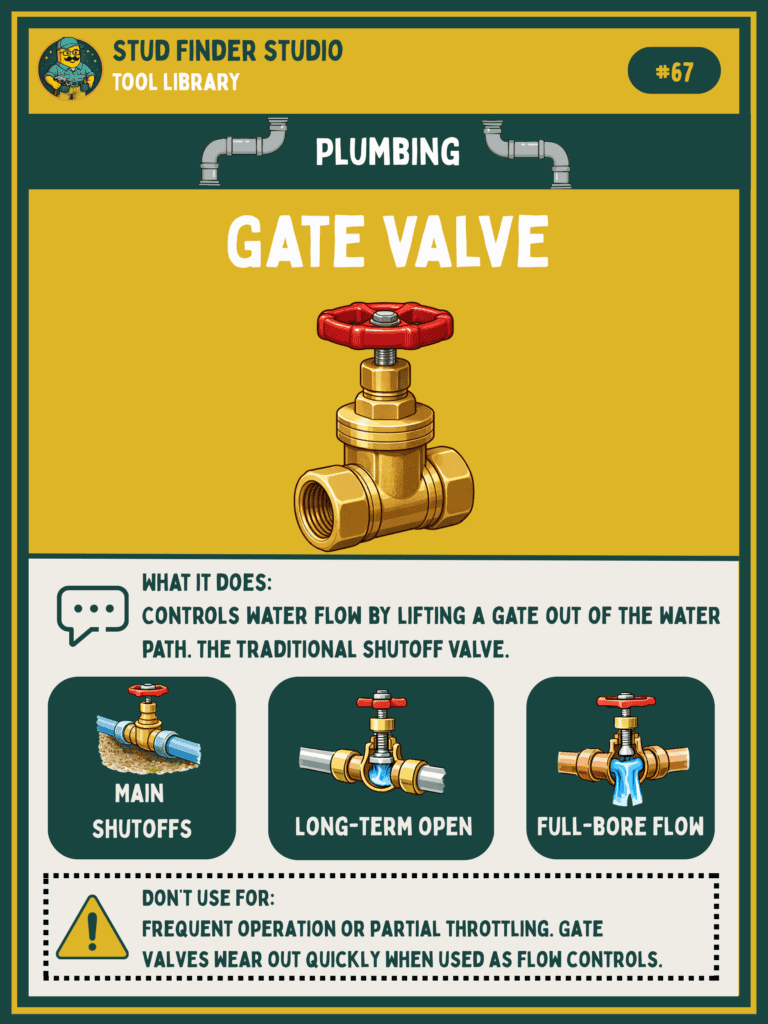
Gate Valve (Most Common in Older Homes)
A gate valve has a round wheel handle that you turn multiple times to open or close. It looks like an old-fashioned faucet handle. When you turn it clockwise (righty-tighty), it closes. Counterclockwise opens it. These valves require several full rotations to shut completely, and they’re known for getting stiff or stuck if they haven’t been used in years.
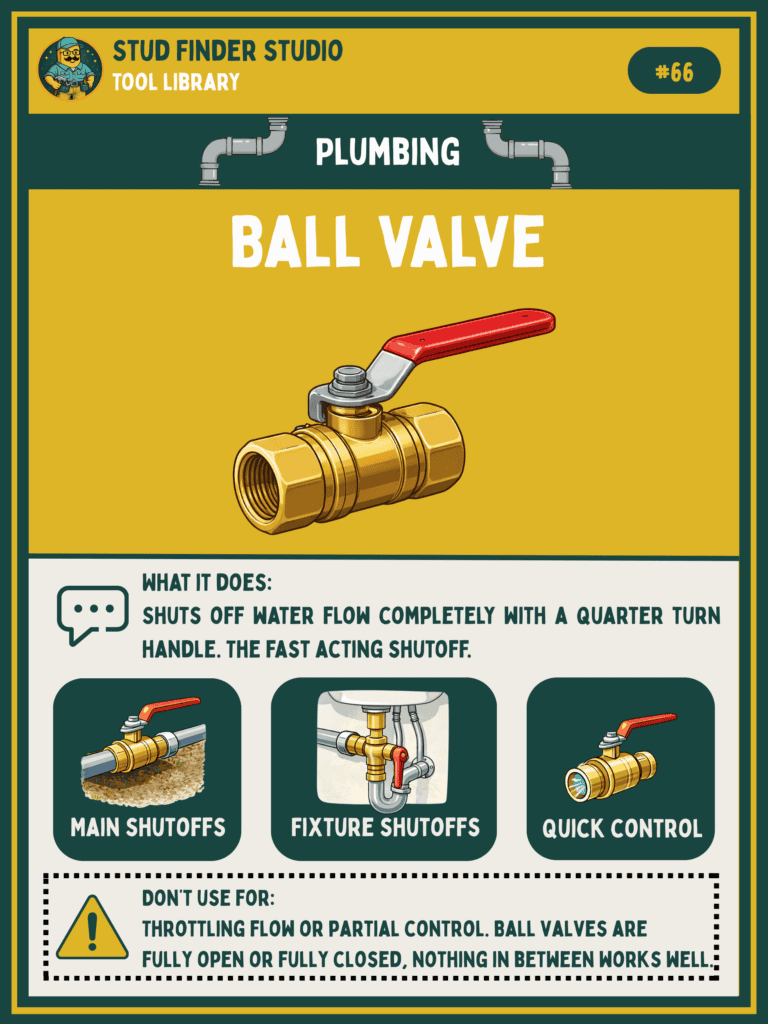
Ball Valve (Common in Newer Homes)
A ball valve has a lever handle that moves about 90 degrees. When the lever is parallel to the pipe, the water is on. When it’s perpendicular (at a right angle), the water is off. These are faster to operate and tend to be more reliable over time because they have fewer moving parts.
How to Identify It Among Other Valves
The main shutoff is on the pipe coming directly from outside, usually the largest water pipe in the area. It’s before the water meter (if you have one visible) on the house side, or right after the meter. If you see multiple valves, the main shutoff is the one closest to where the pipe enters your house from the foundation or ground.
Don’t confuse it with fixture shutoffs (small valves under sinks and toilets) or zone shutoffs (valves that control water to specific areas). The main shutoff is larger and controls everything.
Want to learn more about these and other essential plumbing tools? Check out our Tool Reference Library for detailed guides on valve types, wrenches, and emergency repair tools every homeowner should know about.
How Do I Turn Off My Main Water Supply?
Once you’ve found the valve, here’s how to shut it off.
For a Gate Valve (Wheel Handle)
Turn the wheel handle clockwise. It’ll take multiple full rotations, anywhere from 5 to 20 depending on the valve. Keep turning until it stops and you feel solid resistance. Don’t force it past that point.
If the valve is stiff, you can use a bit of pressure, but if it feels like it’s going to break, stop. A valve that hasn’t been turned in 10+ years can seize up, and forcing it can cause the valve stem to snap or start leaking.
For a Ball Valve (Lever Handle)
Turn the lever 90 degrees so it’s perpendicular to the pipe. That’s it. The water stops immediately.
Ball valves are much faster and usually easier to operate, which is why newer construction tends to use them.
What to Expect When You Turn It Off
Once the valve is fully closed, open a faucet on the lowest level of your house to let any remaining water in the pipes drain out. You’ll hear the water pressure drop and the flow will stop within a few seconds. Upstairs faucets might still dribble briefly as gravity empties the pipes, but the water should stop completely within a minute.
If water keeps flowing after you’ve fully closed the valve, you either didn’t turn it far enough, or the valve is damaged and not sealing properly. In that case, you’ll need to shut off the valve at the street (if you have access) or call your water company immediately.
What If I Can’t Find My Water Shutoff Valve?
Sometimes it’s just not where you expect it to be.
Check Your Home Inspection Report
If you bought your house recently, the home inspection report usually notes the location of the main water shutoff. Look in the plumbing section.
Ask the Previous Owner or Your Neighbors
If you’re in a development where homes were built around the same time with similar layouts, your neighbors probably have their shutoff in the same spot. Ask someone who’s lived there a while.
Call Your Local Water Company
They have records of where water lines enter properties and can often tell you the most likely location based on your home’s age and layout. Some companies will even send someone out to show you if you’re a new customer.
Look for the Water Meter First
If you can find your water meter (usually in the basement or outside in a ground box), the main shutoff is almost always within a few feet of it on the house side of the meter.
What If the Valve Won’t Turn?
If you find the valve but it’s stuck, don’t force it during an emergency.
A seized valve that hasn’t been operated in years can break if you apply too much torque. The valve stem can snap off, the packing can fail, or the valve body can crack. All of these create bigger problems than you started with.
During an Emergency
If you have an active leak and the valve won’t budge, your next option is the curb stop valve (the shutoff at the street, usually in that ground-level box near the property line). You’ll need a curb key (a long tool with a handle) to reach down and turn it. Most hardware stores sell them, but if you don’t have one, call your water company. They can shut it off from their end.
After the Emergency
Once things are under control, hire a plumber to replace the main shutoff valve. If it’s seized now, it won’t work next time either. This isn’t a repair you want to put off.
When You Actually Need to Know This
There are a few situations where knowing your shutoff location isn’t optional.
Active Leaks or Burst Pipes
This is the obvious one. When water is spraying or flooding, every second counts. If you’re fumbling around looking for the valve while water spreads across your floors, you’re adding hundreds or thousands of dollars to the damage total.
Before Plumbing Repairs or Upgrades
If you’re replacing a faucet, installing a new toilet, or doing any work that involves disconnecting water lines, you’ll need to shut off the main supply. Fixture shutoffs (the small valves under sinks and toilets) don’t always work or hold reliably, so having access to the main shutoff is your backup.
Before Extended Vacations
If you’re leaving your house empty for more than a few days, especially in winter, shutting off the main water supply eliminates the risk of leaks, burst pipes, or slow drips turning into damage while you’re gone. You’ll drain the lines afterward by opening faucets to let residual water out.
During Freezing Weather if You Lose Heat
If your heat goes out in winter and you can’t get it fixed immediately, shutting off the water and draining the pipes can prevent them from freezing and bursting.
How I Learned This the Hard Way
I didn’t pay attention when our home inspector walked through our 1923 house. First home, figured I’d learn it all eventually.
Three years later, I was framing a basement wall. The basement was unlevel, so I had to build the wall in place. When I screwed in one of the studs to the top plate, the screw was slightly offset and pierced the water supply line to the fridge. Water started dripping fast.
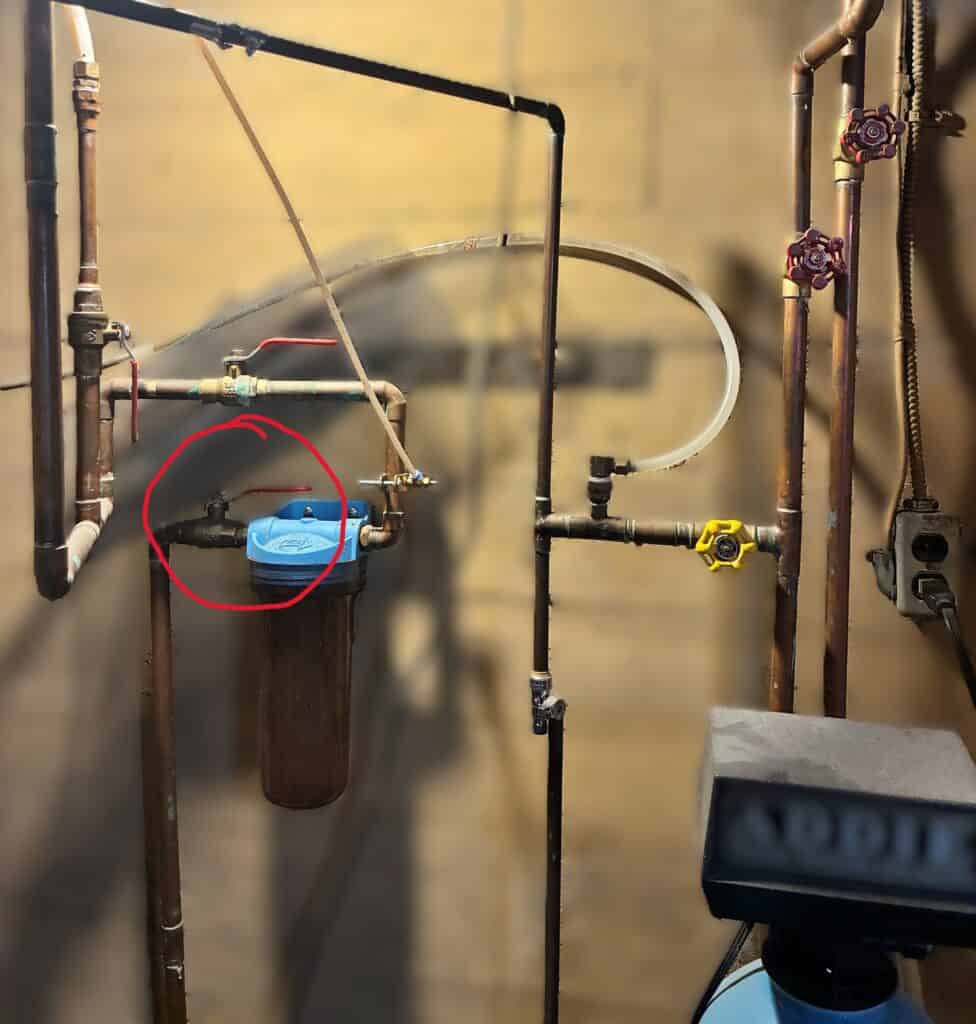
I had no idea which valve controlled the main water. Picked the red one next to the blue filter and turned it. The water stopped.
Now I know exactly where it is. And I’ll never ignore a home inspector again.
One More Thing: Test It Now, Not During an Emergency
Here’s what most people don’t do: they find the valve, make a mental note, and assume it’ll work when they need it.
Then ten years later, there’s a leak, they try to turn the valve, and it won’t move. Now they have two problems.
After you locate your main shutoff, turn it off and back on while everything is calm. Make sure it operates smoothly. If it’s stiff, you can try using a bit of lubricant on the stem (for gate valves) or gently working it back and forth a few times. If it feels like it’s going to break, call a plumber to replace it before you actually need it in an emergency.
Valves that sit unused for years can seize up. Testing it now, when there’s no pressure and no emergency, is the smart move.
Final Thoughts From Stud Finder Studio
Finding your main water shutoff valve isn’t dramatic or exciting. It’s one of those quiet tasks that feels optional until it suddenly isn’t. And by then, it’s too late to do it calmly.
Spend ten minutes today finding it, labeling it if it’s tucked behind storage or in an unfinished area, and testing it to make sure it actually works. That ten minutes might save you from dealing with flooded floors, ruined belongings, and a five-figure cleanup bill because you couldn’t stop the water fast enough.
It’s not about being paranoid. It’s about being ready for something that happens to a lot of homeowners eventually. Pipes leak. Fittings fail. Hoses burst. When that happens, knowing exactly where your shutoff is and how to use it makes the difference between a quick fix and a disaster.
This is part of a broader approach to understanding your home’s systems before you’re forced to learn during an emergency. If you’re just starting to think through how your house actually works and what you should know as a homeowner, How to Hang Anything on a Wall Without Ruining Drywall covers the mindset of treating your home like the system it is, not just a static structure.
Related Articles You Might Find Helpful:
Understanding This Surprisingly Useful Tool, The Stud Finder – Finding what’s behind your walls
How to Mount a TV Without Regretting It Later – Understanding home systems and structure
How to Hang Anything on a Wall Without Ruining Drywall – Foundational home systems mindset
Studs vs Drywall Anchors: When Each One Actually Makes Sense – Decision framework for home projects