
How to Hang a Heavy Mirror Without It Falling
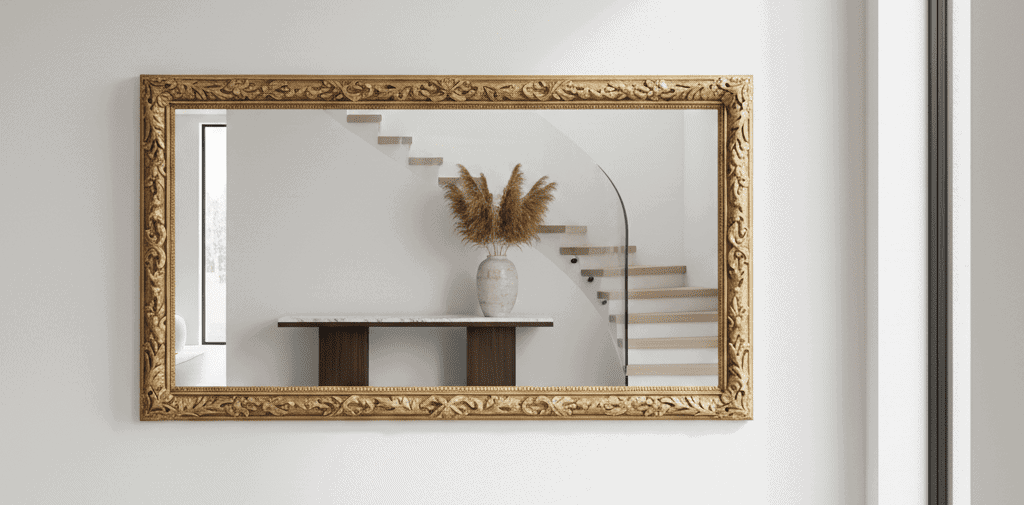
The mirror is leaning against the wall where you want it. You’ve measured the height three times, moved it up an inch, back down half an inch, and now you’re standing there with a pencil in one hand and a level in the other, wondering if the hardware that came in the box is actually going to hold.
Mirrors are different. They’re not just heavy, they’re fragile. And unlike a shelf that might sag or a picture that slides down slowly, a mirror doesn’t give you warnings. It either stays or it doesn’t. When it doesn’t, you’re not dealing with a repair. You’re dealing with broken glass and a wall that needs patching.
This is the project where “good enough” has real consequences.
⚠️ Affiliate Disclosure:
Some of the tools and hardware mentioned here include affiliate links. If you click and buy, we may earn a small commission, at no extra cost to you. We only recommend products we’d actually use ourselves.
Why Mirrors Fail Differently Than Other Wall Items
Most things you hang distribute their weight across multiple points or have some give when things shift. Mirrors don’t work that way.
When you hang a mirror, especially a large one, all that weight concentrates at the hanging points. There’s no bracket underneath supporting it, no arm extending outward to distribute force. The hardware is doing all the work, and if that hardware fails or if it’s mounted to something that can’t handle the load, the mirror comes down.
The other factor that makes mirrors unforgiving is the material itself. A framed picture might survive a fall if the wire gives out. A mirror doesn’t. Once it hits the floor, you’re not rehanging it. You’re cleaning up glass and starting over.
This is why the approach to hanging a mirror needs to be different from hanging almost anything else. It’s not about getting it level and calling it done. It’s about making sure the failure mode isn’t catastrophic.
Understanding How Much Your Mirror Weighs
Before choosing hardware or deciding where to mount, you need to know what you’re actually dealing with. Mirror weight isn’t obvious, and guessing wrong is how people end up with hardware that was never adequate for the job.
Small to medium mirrors (under 20 pounds) can usually work with quality drywall anchors if installed correctly, though studs are still better.
Large mirrors (20-50 pounds) should be mounted into studs or use heavy-duty hardware designed for the weight.
Very large mirrors (over 50 pounds) need studs, period. This isn’t optional. At this weight, you’re also looking at two-point mounting systems for redundancy.
If you’re not sure what your mirror weighs, a bathroom scale works. Weigh yourself, then weigh yourself holding the mirror. The difference is the mirror weight. It’s low-tech, but it’s accurate.
For reference, a typical 24×36 inch framed mirror with a wood frame weighs around 15-20 pounds. A 30×40 inch mirror can easily hit 30-40 pounds depending on frame material and glass thickness. Large decorative mirrors over 48 inches can exceed 50 pounds.
The weight matters because it determines everything else: hardware type, mounting method, whether you can work alone, and how much margin for error you have.
Hardware That Actually Holds Mirrors
Not all hanging hardware is designed for mirrors, and using the wrong type is one of the most common reasons mirrors fail.
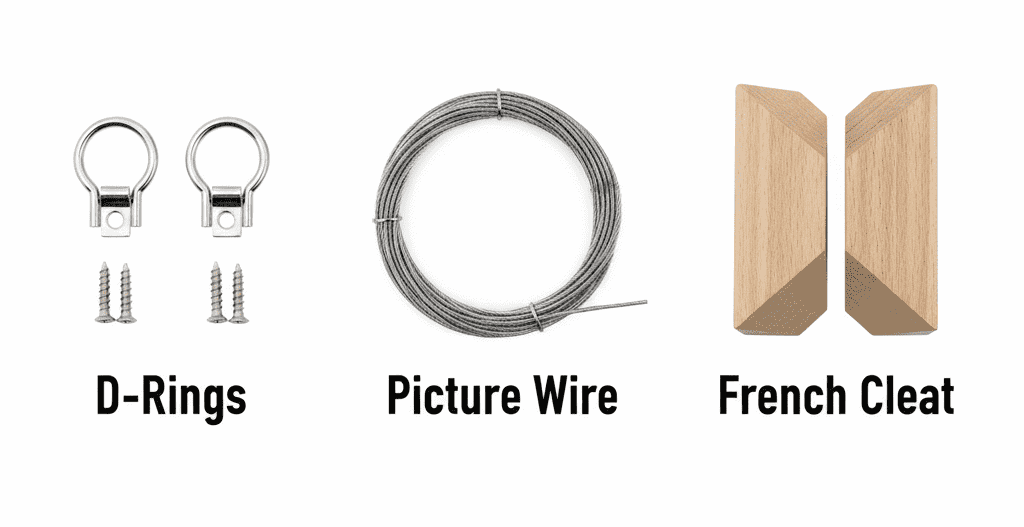
D-Rings and Screws
D-rings are metal loops attached to the back of the mirror frame. They’re simple, direct, and handle weight well when installed into studs.
Pros:
- Weight transfers directly into the wall
- No single point of failure if using two D-rings
- Easy to level during installation
- Reliable for heavy mirrors
Cons:
- Requires precise stud location
- Less forgiving if studs don’t line up with mirror width
- Mirror sits slightly off the wall
D-rings are the go-to for heavy mirrors when studs are available. They’re not decorative, but they work.
Picture Wire
Picture wire runs between two hanging points on the back of the frame and drapes over a wall hook or screw. It’s common for smaller framed artwork, but it has limitations for heavy mirrors.
Pros:
- Allows some flexibility in horizontal positioning
- Works with a single wall anchor point
- Familiar and easy to install
Cons:
- Creates a single point of failure at the wall hook
- Wire can fatigue and break over time
- Makes leveling more difficult
- Not ideal for mirrors over 30 pounds
If you’re using wire, make sure it’s rated for at least double your mirror’s weight, and inspect it regularly for fraying or wear.
French Cleats
A French cleat is a two-part mounting system with matching 45-degree beveled edges. One piece mounts to the wall (across multiple studs), and the other attaches to the back of the mirror. They interlock when hung.
Pros:
- Distributes weight across a longer section of wall
- Extremely stable once mounted
- Can handle very heavy mirrors (75+ pounds)
- Easy to remove and rehang
Cons:
- More complex installation
- Mirror sits farther off the wall
- Requires more precise mounting to the mirror frame
For mirrors over 50 pounds, French cleats are often the best choice. They’re overbuilt for the job, which is exactly what you want with something heavy and fragile.
Finding Studs for Your Mirror
With a heavy mirror, finding studs isn’t a nice-to-have. It’s the foundation of the entire install.
Use a stud finder to locate framing behind the drywall. If you haven’t used one recently or want to make sure you’re getting accurate readings, Understanding This Surprisingly Useful Tool, The Stud Finder walks through how to use one reliably.
Once you’ve found studs, mark their locations and verify they’re actually where the tool says they are. A small test hole in an area that’ll be hidden by the mirror is worth it for peace of mind.
The challenge with mirrors is that studs don’t always line up with where you want the mirror to hang or with the D-ring spacing on your frame. When that happens, you have a few options:
Adjust the mirror placement to work with the studs you have. Sometimes shifting the mirror a few inches left or right solves the problem without compromising the look.
Use a French cleat that spans across multiple studs, giving you more flexibility in horizontal positioning while still tying into structure.
Install a backing board between studs during a remodel (or through drywall surgery if you’re committed) to create solid mounting points exactly where you need them.
What you don’t do is force the install with anchors when the mirror is too heavy for that approach. For a complete breakdown of when studs are necessary versus when other options can work, Studs vs Drywall Anchors: When Each One Actually Makes Sense explains the decision framework.
Installation Steps That Prevent Regret
1. Measure and Mark With a Partner
Large mirrors are awkward. Holding one at the right height while trying to mark mounting points solo is how walls get dinged and measurements get messed up.
Have someone hold the mirror at the intended height while you step back and confirm placement. Once it looks right, mark the top edge and the mounting points. Use a level to verify everything is straight before drilling.
2. Install Hardware First, Test It
If you’re using D-rings or screws into studs, install the wall-mounted hardware first and test it before putting the mirror anywhere near it. Hang something heavy from each mounting point and pull down hard. You should feel zero movement.
If anything flexes, creaks, or feels soft, stop. That’s the wall telling you something isn’t right. Either the hardware didn’t hit the stud solidly, or the framing isn’t as robust as you expected.
3. Use a Two-Person Hang
Hang the mirror with help. One person supports the weight while the other guides the hanging hardware into place. Trying to do this alone with a heavy mirror is asking for a dropped frame or a hasty mount that’s not quite level.
4. Level It Before Letting Go
Once the mirror is on the wall, check level before assuming it’s done. A mirror that’s even slightly off looks wrong, and it’s much easier to adjust it now than after you’ve walked away and looked at it for a week.
5. Test the Hold
After hanging, gently pull the bottom of the mirror away from the wall. Not hard enough to risk anything, just enough to confirm the mounting points are secure and nothing shifts. If the mirror moves or you hear any settling sounds, something needs adjustment.
When Redundancy Matters More Than Aesthetics
For mirrors over 40 pounds, redundancy stops being optional and starts being insurance.
Two-point mounting means the mirror hangs from two separate points instead of one. If you’re using D-rings, each ring should be screwed into a stud. If one side fails, the other still holds while you figure out what went wrong.
Safety wire backup is a secondary wire that doesn’t carry load during normal use but catches the mirror if the primary mounting fails. It’s not elegant, but it’s effective, and for very heavy mirrors in high-traffic areas, it’s worth considering.
The principle is simple: with a heavy, fragile object, you don’t want a single point of failure. Whether that’s using two D-rings into separate studs or adding a backup wire, the goal is to make sure that if something does give out, the mirror doesn’t hit the floor.
Where Drywall Anchors Can (And Can’t) Work
For lighter mirrors under 20 pounds, quality drywall anchors can work if you install them correctly and understand their limits.
But “can work” and “should be trusted” are different things. Anchors rely on drywall staying intact around them over time, and drywall compresses, cracks, and weakens with age and vibration. A mirror that weighs 18 pounds isn’t a great candidate for anchor-only mounting just because the anchor is rated for 50 pounds.
The issue is that weight ratings on anchors assume perfect conditions: new drywall, no movement, straight downward force. Mirrors introduce variables. They get bumped during cleaning. They vibrate when doors slam. Small stress over months or years loosens anchors in ways that don’t show up until failure.
If you’re trying to estimate whether drywall can handle your specific mirror, How Much Weight Can Drywall Really Hold? covers realistic capacity and why leverage and time matter more than raw pounds.
For anything over 20 pounds, studs are the better call. For anything over 40 pounds, studs are the only call.
Common Mistakes That Lead to Broken Mirrors
Trusting picture wire alone for heavy mirrors. Wire works fine for small frames. For mirrors over 30 pounds, it’s a single point of failure waiting to happen. If the wire frays, the hook bends, or the wall anchor shifts, the mirror comes down.
Using the hardware included in the box without checking if it’s adequate. Manufacturers include the minimum needed to hang the mirror in ideal conditions. If your mirror is on the heavier end or if wall conditions aren’t perfect, that hardware often isn’t enough.
Hanging on drywall anchors when studs are available. If studs are nearby and you’re just avoiding them for convenience, that’s a bad trade. Anchors might hold, but studs will hold, and with a mirror, certainty is worth the extra effort.
Skipping the load test. After hanging, people assume the mirror is fine because it looks fine. Testing the mounting points before and after hanging catches problems before gravity does.
Working alone with a large mirror. Large mirrors are heavy, awkward, and unforgiving. Trying to mount one solo increases the chance of a bad hang, a dropped mirror, or an injury. It’s not worth the risk.
Tools You’ll Actually Need
- Stud finder (something like the Franklin Sensors ProSensor is reliable for this kind of work)
- Level (24-inch or longer for large mirrors)
- Drill/driver
- Appropriate screws or lag bolts (based on mirror weight and hardware type)
- Tape measure
- Pencil
- Second person (non-negotiable for mirrors over 30 pounds)
Final Thoughts From Stud Finder Studio
Hanging a mirror isn’t like hanging a picture or mounting a shelf. The stakes are different. A picture falls and you rehang it. A shelf sags and you adjust it. A mirror falls and you’re sweeping up glass while figuring out how to patch the wall.
The good news is that hanging a heavy mirror correctly isn’t complicated. It just requires treating the wall like structure, using hardware rated for the actual weight, and not skipping steps because they feel unnecessary.
If you plan around studs, use proper hardware, test the hold before trusting it, and don’t try to solo something that needs two people, you’re not just hanging a mirror. You’re making an install that stays where you put it, because you treated weight and fragility seriously from the start.
This is part of a broader mindset about wall mounting that applies to everything from TVs to shelves. If you’re just starting to think through how walls actually work and what it takes to mount things right the first time, How to Hang Anything on a Wall Without Ruining Drywall explains the foundational principles that make every project more predictable.
Related Articles You Might Find Helpful:
Understanding This Surprisingly Useful Tool, The Stud Finder – Finding studs reliably
How to Mount a TV Without Regretting It Later – Similar weight and mounting challenges
How to Mount a Floating Shelf That Won’t Sag – Another perspective on wall-mounted weight
Studs vs Drywall Anchors: When Each One Actually Makes Sense – Complete decision framework