

Gutters Overflowing Even Though They’re Clean: What to Check Next
You cleared the leaves, cleaned out the muck, and figured the gutters were ready for the next rain. Then water started spilling over the same corner again.
If your gutters are clean but still overflowing, leaves may not be the problem. The next step is figuring out where the water gets stuck or misses the gutter altogether.
Quick Answer
Clean gutters can overflow because of a blocked downspout, a sagging section, incorrect slope, or more runoff than the system can handle. Water can also shoot past the gutter or run behind it. Start by observing where it escapes and whether water is coming out of the downspout. That helps narrow down what needs attention.

Watch Where the Water Escapes
Look from a sheltered window or another safe location during rain. Save any hands-on inspection for dry weather. Don’t climb a ladder during a storm.
A short phone video can be useful when explaining the problem to a contractor. Try to capture the roof edge, the overflow location, and the downspout discharge.
| What you notice | What to check next |
|---|---|
| Overflow near the downspout with little water coming out below | A restriction at the outlet, inside the downspout, or farther along the drain. |
| Water spilling from a visibly low section | Sagging supports or an uneven gutter slope. |
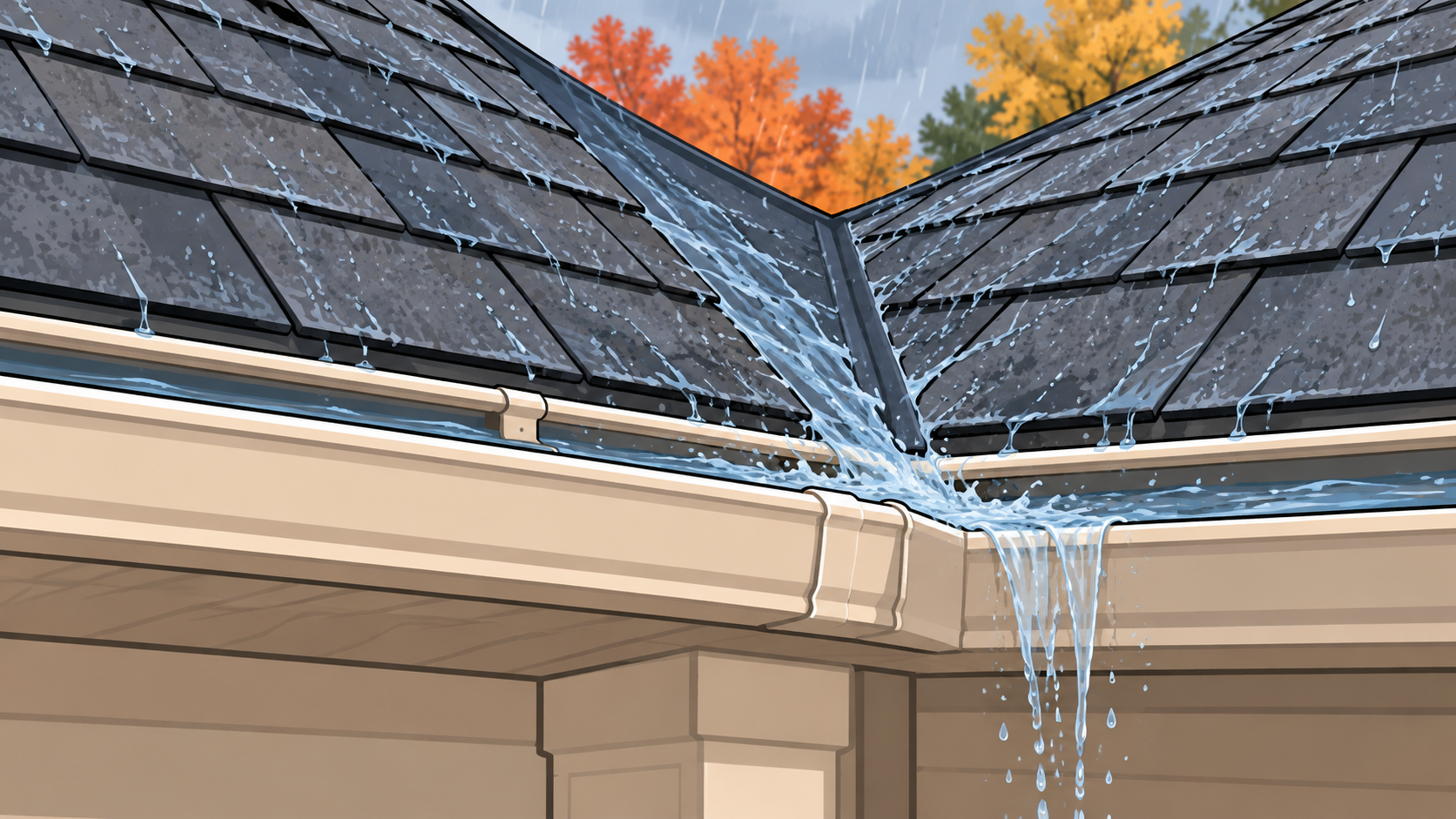
| Water shooting past an inside corner | Concentrated runoff from a roof valley. |
| Water running behind the gutter | Gutter position and the roof-edge flashing. |
| Repeated overflow mainly during heavy rain | Drainage capacity, after checking for restrictions. |
These are clues, not a diagnosis. More than one issue can happen at the same time.
A Clean Gutter Doesn’t Mean the Downspout Is Clear
Leaves can disappear from the trough and lodge inside an elbow. A crushed extension or blocked outlet at ground level can also restrict drainage.
From the ground, check accessible outlets for packed debris, damage, or an extension that has folded shut. If the downspout connects to an underground pipe, the restriction may be somewhere you cannot see.
Weak discharge during obvious gutter overflow is worth investigating. It does not automatically mean you need a larger gutter.
If debris is still part of the problem, our guide to gutter-cleaning tools explains the different cleaning options.

Check for a Low Spot
Gutters need a consistent fall toward their outlets. A sag can create a pocket where water collects before it reaches the downspout.
From the ground, look for a dipped section or a gutter pulling away from the fascia, the board behind it. A contractor can check the slope and whether the supports have a sound place to attach.
Adding sealant will not correct a low spot. The gutter may need its supports reset, and damaged backing may need repair first.
Sometimes the Water Misses the Gutter
A roof valley channels runoff from adjoining roof slopes into a concentrated stream. At that location, water may overshoot the front edge even when the gutter is clear.
Water running behind the gutter is a different clue. The gutter’s placement or roof-edge flashing may need attention.
Have those details checked before adding splash guards or replacing the whole run. The repair should address how water reaches the gutter as well as how it drains.
What If It Only Overflows in Heavy Rain?
Once restrictions and slope problems are ruled out, the system may need more capacity. That could mean larger outlets, additional downspouts, or a different gutter size.
The right combination depends on the roof area feeding that section and local rainfall conditions. A bigger trough alone may not solve a limited outlet.
Gutter guards also need consideration if water started bypassing the gutter after installation. They do not correct poor slope or insufficient drainage capacity.
Know When to Get Help
Arrange an inspection if overflow keeps returning, the gutter is loose, or water is soaking the fascia, siding, or ground beside the foundation. Leave repairs requiring roof access or difficult ladder work to a qualified contractor.
For now, record where the water escapes and what happens at the downspout. Those observations give you a useful starting point for fixing the cause.
Related articles: